skip to main |
skip to sidebar
A spectacular week of early summer-like weather in February is coming to an end soon but we still have a few days left to enjoy. Checking out eastbound St. Vrain Greenway, including this portion below that was just re-opened last week from the 2013 flood damage, just west of 119th Street.
Heading further east, you can even go under CR1 now, it's no longer blocked off:
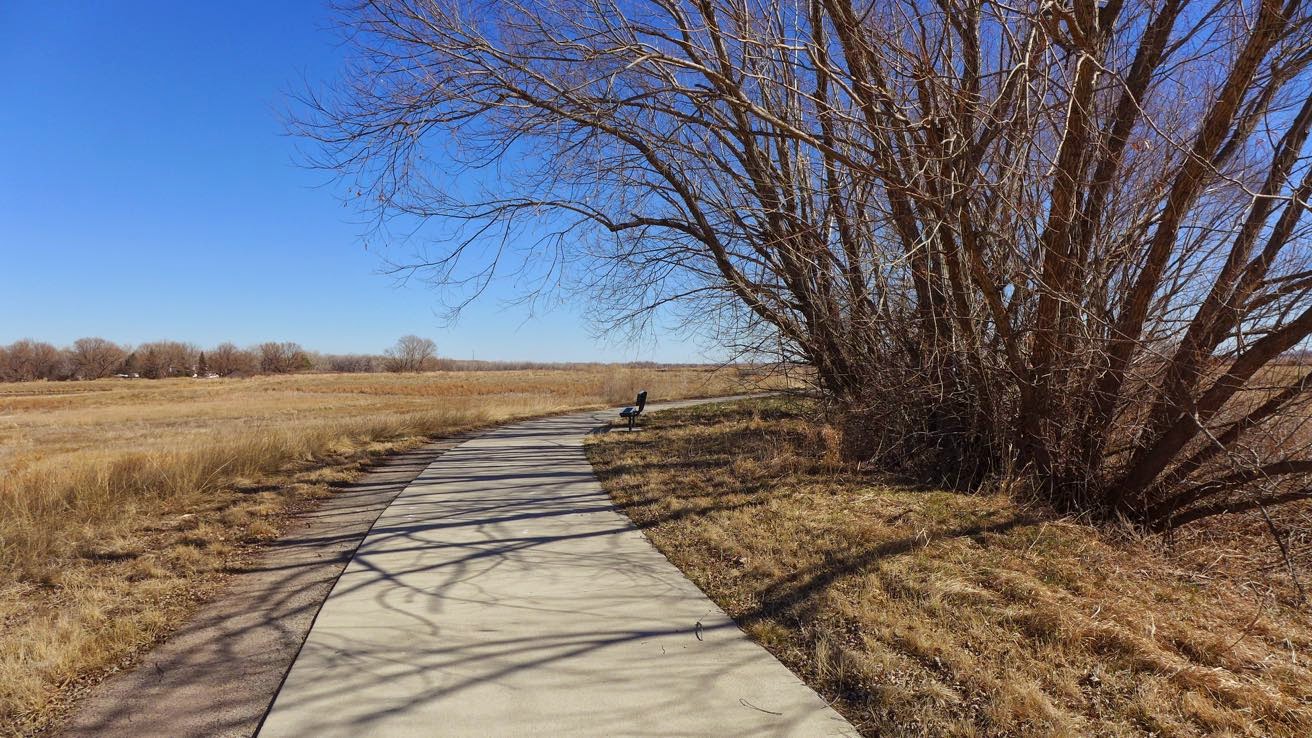
Hard to believe that it's been over a year and a half since I've seen this bench. The clump of trees provide some nice shade in the summer.
You can only go a little further east from the bench. The rest of the way to Sandstone Ranch is closed.
Westbound on the return. Hello Indian Peaks!
A cool, fall-like morning greeted riders of the annual testosterone-free Venus De Miles cycling ride, which offers three distances and starts in Longmont's Prospect neighborhood. It's hard to believe that this is the seventh edition. Last year's event, scheduled for late September, was canceled due to the big flood.
Alternate title: My humble front-page adventure with cycling advocacy.
Emery Street is one of Longmont's original north-south streets, named after H. D. Emery who was a newspaper reporter in Illinois in the late 1860's and was also involved in selecting Longmont's location, first known as the Chicago Colony. South of Third Avenue, Emery Street is a quiet, somewhat neglected street running through an industrial area before crossing some bumpy train tracks to reach 1st Avenue.
In 2008, a proposal was drawn up by the Butterball Turkey plant to permanently close a section of Emery Street south of Third Avenue, between 1st and 2nd Avenue. Such a proposal had been brought up a few times already without success by Butterball's predecessor ConAgra but this one appeared to have momentum among local business leaders and some support from the city as well. Butterball's reasoning was that Emery Street bisected their factory on the west side and a spice warehouse on the east and that increased FDA security requirements were calling for this area to be better locked down. As long as a public street went through this area, the security requirements could not be met and they had data to show that this part of Emery Street was lightly used. As a bicycle rider who used the targeted section of Emery Street regularly to get to and from downtown for a volunteer gig, I was quite taken aback by the idea that part of my quiet backstreet cycling route to/from downtown would be fenced off forever, and that a block of a longstanding public city street could actually be taken off the map. I was reminded, however, that the City of Longmont did do just that with Kimbark Street when the Justice Center was built.
A map of the area instantly reveals the cycling problem. As I was heading north to downtown, coming from the St. Vrain Greenway to the south, I'd take an exit path to 1st Avenue, go west on 1st Avenue, and then go north on Emery. You'll notice the lack of north/south roads in this industrial/railyard area of town. If Emery Street was closed, my options would be to ride the sidewalk on Main Street, which is never encouraged, or go over to Martin Street which six years ago was not improved and in general, was an unsafe cycling road (this was before the Martin Street bridge was built).
I wrote up my concerns and sent them to both to the Bicycle Longmont mailing list and to my City Council members. Immediately I received feedback from other cyclists who also used Emery Street, some of which noted that Longmont already had a shortage of north/south cycling routes and that this proposed closure would just make this situation worse.
The leader of Bicycle Longmont at the time suggested that I present the cycling position to the upcoming Emery Street closure hearing at the Planning and Zoning (PZ) Commission meeting, since he couldn't make the meeting and it would be good for them to hear from someone else on this subject. This wouldn't be a binding meeting to decide the issue but it would drive a recommendation from PZ to City Council.
The Times-Call was doing a story on the issue and called me to ask if I would meet their photographer (Richard Hackett) at Emery Street for a picture. Hmm, what did I get myself into? I pedaled over there after work on my trusty Trek 830 and met Richard for a photo (blocking the street!).
Front page of the Times-Call on May 20, 2008:
I arrived at the meeting at city chambers on Wednesday, May 21, a little nervous seeing the sizable audience, and put my name on the list of "public invited to be heard." First up, Butterball and its consultants presented their case and showed their traffic data. Employment of hundreds was a major point of their case: if their security needs could not be met, the plant may have to look elsewhere. A local architectural firm then showed their plan on how they'd link the two buildings when the designated block of Emery Street became private property.
When it was time for public comment, a few speakers preceded me from the business community (LAEC, LDDA, etc.) in general support of the closure, with each of them mentioning the potential for lost jobs. When it was my turn at the microphone, I attempted to make the cycling case for keeping the road open, and as an alternative, requested that at least a multi-use path should be provided around the east side of the spice factory, to allow safe access to/from downtown until alternative routes were available from planned city road work. We were clear that our position was not anti-business. Others that followed me were mixed yes/no for the road closure. Of the "no's", some just didn't want the plant there to begin with or didn't like the product, a 1st Avenue business owner or two said it would impact their operations and customer access, and a former ambulance crew member reminded the audience that Emery Street had been an important emergency route when a train accident during the previous decade closed Main Street causing a chemical spill.
The PZ board members then started their discussion in which the cycling issue did get some attention. A city representative mentioned the poor shape of Emery Street around the train tracks and brought up the projected future way of cycling from the Greenway to downtown, namely the upcoming Martin Street extension. Emery Street, they said, would become less significant once that was built. An extension of Boston Street (east/west) to Martin Street was also brought up (mentioned in article above, too) but as of 2014, the city is still working on this. Butterball said that the suggested path was a possibility but that liability, lighting, plant security, path user safety, and budgeting were the concerns. The discussion then proceeded to go in the "visioning" direction about what this area of town might look like in the future. At the end of the evening, nothing was really decided but everyone was heard.
So what happened to the Emery Street closure proposal? As I remember, after the PZ meeting, Butterball and their consultants were going to study the situation for a bit longer and potentially come up with a modified plan, including investigation of the proposed path. A few months later, the financial crash of 2008 was in full force, hobbling the investment markets and tanking the economy. I'm unsure if this had anything to do with an updated Emery Street proposal, but I don't believe anything was ever brought back.
Fast forward six years later and you'll find this once-forgotten area of town is starting to get some attention. Butterball left town in 2011, for reasons unrelated to the Emery Street matter, leaving behind a vacant factory with a "For Sale" sign on it. During that time, the city rezoned the Butterball property from light industrial to mixed residential, in hopes of attracting a more appropriate southern entrance to Longmont than a poultry operation in a soviet-gray factory. A potential buyer of the property in Denver has recently been identified who hopes to bulldoze the Butterball plant and build a residential/business complex on the site. [[Note: It's just been reported today, May 19, 2014 that the Butterball site has indeed been purchased for $4.46 million.]] New businesses including a microbrewery have opened along 1st Avenue, the popular Cheese Importers is just across Main Street, and two blocks away will be the proposed Main Street transit station and surrounding businesses for the day when Longmont finally has a commuter train or a bus rapid transit system.
South Emery Street today, very close to where the picture above was taken in 2008. Hasn't changed at all except for a few new cracks in the road. The lone tree on this block is still doing well:
The problematic spice warehouse:
Whenever I'm riding in this area today, I often wonder what would have happened to Emery Street if the closure had been approved back in 2008. Would it have remained fenced off today and passed on to the eventual new owner of the property? Or would the street have been returned to the City upon the plant closing, and be re-opened to the public?
Six years later, it's clear that south Emery Street has a revitalized future, especially if the proposed development goes forward.
A windy ride to the water tank (above 75th & Lookout) via the LoBo trail before the next round of snow comes in.
Because of flood damage, Ogallala Road via 95th remains the only way to get to the LoBo trail from Longmont.
Flying saucer clouds provide the accompaniment along LoBo, looking at Boulder in the distance:
Little piece of singletrack near Lefthand Valley Grange Park in Niwot:
The hill, summitting at 75th and Lookout:
The destination:
The cycling world was shocked today with the sad news that American cyclist Amy Dombroski was killed on the roads of Belgium during a training session.
Amy used to be a regular on the cyclocross circuit as it made its annual swing through the Boulder area and as a transplanted Boulder resident, she could be seen on the local roads and trails in the summer. Two years ago, in an all-out effort to improve, she passed up the comforts of the USA cyclocross racing season and moved to Belgium for half the year to fully immerse herself in the intense cross culture there and to race against the best in the world every weekend. Sadly, she had just returned to Europe this past weekend to start her third winter on this pursuit.
Amy was always a hit with spectators and was known for her big smile. I'll always remember her for her grit and determination while racing. As a smaller rider than most of her competition, she had to work harder but that never seemed to be an obstacle to her passion for riding and racing bikes, all year round. On a Longmont connection, she gave several cyclocross clinics here to a local cycling club at Rogers Grove (including some instruction for kids) and raced to 5th place in the muddy 2009 Blue Sky Cup over at the Xilinx campus.
A few pictures that I took from when Amy Dombroski used to race here.
Boulder Cup 2008 at the Boulder Reservoir, Amy in the red:
2009 Blue Sky Cup, Longmont:
Boulder Cup 2009, Boulder Reservoir:
Longmont Bike Night #2 of 2013 on May 22, as it enters its tenth year! Although I haven't been a regular the last year or two, I've attended each year and still remember the original flyer in the window of the old High Gear bike store that advertised the first ride.
Friendly volunteers like these have been with Bike Night the last few years, patrolling the intersections and stopping cars as the riders go by.
Remembering the lean years when perhaps only a handful of riders would turn out, it's routine now to get 200 or more participants each Wednesday. Ryan, the organizer, had a great idea and stuck to it.
Opening night of the 2010 Bike Night season is here.
One thing that has remained the same over the ten years: the ride starts at 6:30 PM on Wednesdays, at the Longmont Senior Center. C'mon out!
This is the story of a Trek 830 All Terrain Bike (ATB) that I bought in 1984 while in graduate school, in Tallahassee, Florida. Fueled by great consumer interest of fat tire bicycles, a trend that was started in the late 70's in Marin County, California, this was one of Trek's first models in this genre. The trend captured me, too. I had never heard of Trek before walking into Rainbow Cycles on W. Tennessee Street in Tallahassee (the store is long gone) to take a look at these strange new bikes. A few test rides later, I plunked down $350 (a lot of bucks back then) for a 15-speed (3 x 5) Trek 830, painted in berry red.
ATBs from back then are not today's Mountain Bikes. They were too heavy to do any serious climbing but they were built like a tank and seemed to be indestructable.
Here's what it looked like from the original brochure, thanks to the great Vintage Trek site:
Instantly I had new freedom on where I could ride and was not limited to the roads anymore. A friend (who also had an ATB) and I rode thousands of miles that year on dirt roads in the national forests south of town all the way to the Gulf of Mexico, crossing through water, jumping logs, and flying over paths covered with oyster shells. Country road dwellers were astonished to see strange college kids pedaling down their dusty dirt roads on bikes.
Four years later, I was done with school and started a series of moves along the east coast. With the exception of some occasional neighborhood rides with my kids, the 830 was relegated to collect dust in various garages and basements. Though I acquired other bikes, I hung on to it through the years, and it made it to Longmont with me in the 90's. Even then, however, I was riding the roads again on lighter bikes, and the dust continued to pile on the 830. I would occasionally use it as a beater, an informal name given to a bike that you use around town and don't mind if it gets nicked or stolen, but that was it.
The 830 in 2003, still going. No quick release wheels, you'll notice:
As recently as 2005, my 830 was mostly intact, all original parts, except for the tires. Age caught up with it, however, and things started to break. The Sun Tour front dérailleur cracked one day going up Coffman to the post office. The heavy, rock sturdy aluminum wheels lost some spokes and their trueness. The rear dérailleur was also worn out, as were the rear sprockets making every gear shift attempt a noisy adventure. The bottom bracket was grinding like some pebbles thrown in a blender at low speed. I opened it up and found a lot of the ball bearings had been ground up to powder.
The original SunTour front derailleur, cracked:
In the early 80s', SunTour was bigger than Shimano. They were anonymously absorbed in the mid-90's. Original rear derailleur (SunTour Mountech) and Atom (French) five-speed freewheel cluster:

I let it sit for a few more years, sparing it from becoming a nice steel contribution to the Eco-Cycle dumpster on Martin Street, probably for sentimental reasons. I was past trying to preserve it as an original but was still open to getting it back on the road. A set of lighter mismatched 26" MTB wheels found at a bike gear swapfest was the trigger that got me started. I suddenly had quick-release wheels, if I could get them to fit. The rear hub on the new wheel, however, was too wide to fit in the frame so I had to slightly spread the frame. This trick can only be done on a steel bike! A trip to Boulder Community Cycles got me a used front dérailleur in good shape. I found some new parts on sale at Amazon over the period of a year, likely cheap because they were for older style bikes. The finishing touch was a splurge on some new Schwalbe Big Apple balloon tires. Inflated to only 25 psi, they provide a heavenly cushioned ride over any in-town road conditions that Longmont can throw at me.
The sturdy berry-red 830 today, back on the road again. I put a rack on the back to haul groceries, and magazines/books to the Library:
Made in the USA, in Waterloo Wisconsin. Trek would later move production of all but their very high-end bikes to Taiwan:
Reynolds 501 steel tubing frame. Original Rainbow Cycles sticker (Tallahassee, FL).
New 24-speed drivetrain (3 x 8), with SRAM X-5 rear derailleur:
Shimano Alivio triple crank. Behind the crank is a Shimano cartridge-style BB-UN26 bottom bracket, which fit perfectly.
Shimano Deore XT front derailleur:
Still the original saddle:
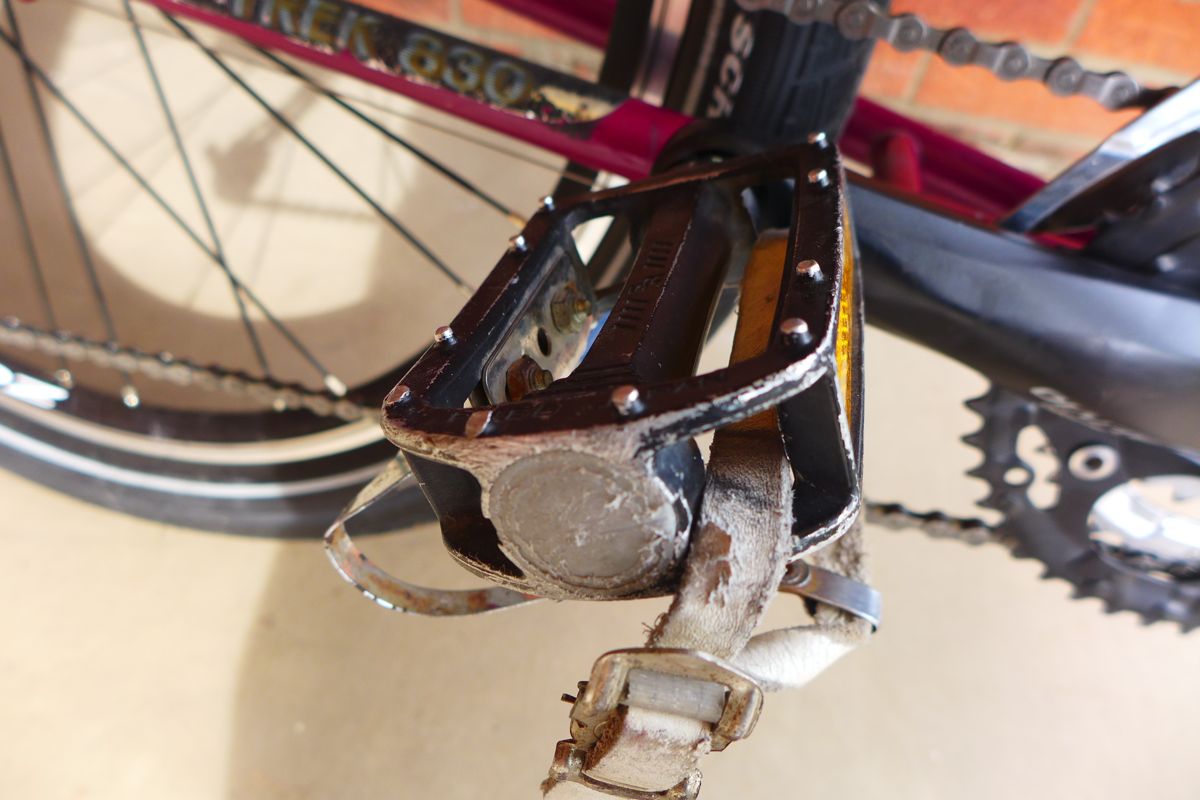
Pedals are original, too:
Schwalbe Big Apple balloon tires:
Nicked up at 29 years old but weren't we all?
Friction shifters are still original but the rear one will not shift to the full range of the rear derailleur, so this will eventually be replaced. The frayed grip will also be gone soon:
A friend pointed out that I could have gone to Walmart and grabbed a new bike for the 125 bucks that I sunk into the 830. He was technically right, of course but there is satisfaction in keeping an older bike on the road that you can't put a dollar figure upon.
And from being mostly unknown back in 1984, Trek went on to become a very famous bicycle brand worldwide, with a lot of their success and fame coming from supplying Lance Armstrong with his bikes on his seven Tour De France victories. The Trek 830 was slightly renamed to "830 Antelope" in the late 80's and 1990's, and seems to have disappeared from the Trek catalog today. Trek does offer a model 820, which is their entry-level mountain bike.
If you're a vintage Trek 830 owner yourself and stumble upon this, I hope some of it is helpful.
 One citizen's view of Longmont, Colorado, USA.