Showing posts with label Weld County. Show all posts

Sunday, January 16, 2011

Weld County Ramble

Out for a ride to the Union Reservoir area on a day that they said the sun would be out but the clouds won instead.  On the Greenway heading east, I noticed that the City has been quietly building two parking lot /trail heads, one at 119th Street (with a new bridge):


New Bridge crossing the St. Vrain

This is just across the highway from the Longmont sugar beet factory and those white hills in the background are the lime deposits that I've mentioned before.


And the other trailhead is about another 1.3 miles east, at Weld County Road 1:


I'm guessing that they are aiming for a Spring time opening.

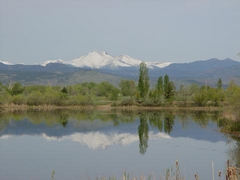
Union Reservoir with a clouded Longs Peak in the background

Four friendly horsewomen out for a ride

Sunday, March 15, 2009

Union Reservoir ride


A windy ride today on the dirt Weld County roads surrounding Union Reservoir, including a visit to the controversial intersection close to the new Mead High School.

I have a thing for mailbox sculpture!


East of the reservoir on County Road (CR) 26, there is a 90-degree intersection with CR7 that is getting a lot of attention right now, because of its proximity to the new Mead High School which is opening up in August 2009.

These next three pictures show the intersection getting closer as you head south on CR7, away from Mead HS:


The intersection goes over a culvert that drains a stream to St. Vrain State Park during wetter times.


The common concern being heard is that this intersection is not safe, especially for teenagers starting to drive. Although I haven't heard this voiced yet, I'm guessing that there are also worries about teenagers just taking this corner too fast, perhaps to show off, especially if two vehicles are both at the elbow point at the same time. It's definitely just a quiet country intersection right now but that's about to change, and it is valid to ask if this intersection could be improved to safely handle the larger expected load.


Mead High School, not too far from I-25:


I'll have to get back to this other intersection in the summer to see the difference from the prescriptive-burn look it has today:


Wednesday, January 21, 2009

Congratulations to the Historic Highlandlake community

Congratulations are in order to the Historic Highlandlake folks for winning a historical preservation award with their effort to save and restore their church:


They'll accept the award next month (February 2009). More about Highlandlake is here.

Sunday, January 18, 2009

Windsor Colorado Sugar Factory

Next up in the northeastern Colorado sugar beet factory series: The year 1903, which was a frantic period in the Colorado sugar beet history, of which Chester S. Morey, a powerful industry leader at the time, described it as:
"Every town that had 300 people wanted a sugar factory. In fact all of them were circulating petitions for acreage."
Three sugar beet factories were opened in the area that year, including two massive facilities in Ft. Collins and Longmont. But the first new factory of 1903 to start slicing beets and producing sugar was in Windsor in November.


Ground was broken for the Windsor factory a year earlier, in November 1902, on the so-called "Hollister place" property, a short distance outside town. The Windsor factory was intended to be an exact duplicate of the Eaton factory located 15 miles away, with the same capacity: 600 tons of beets per day. The factory was funded with stock offered by the Windsor Sugar Company, which had offices in Denver and Windsor. The company's charter was much wider than just sugar manufacturing: they had authorization to pursue business in railway construction, power stations, irrigation and reservoir construction, and livestock breeding.

Like the other factories in the area so far, the Windsor factory was acquired by the New Jersey-based Great Western Sugar Company in 1905. Eric Twitty, in the excellent free Silver Wedge publication (mentioned earlier), has the complete story about the strongarm and hostile consolidation plays that were occuring in the sugar industry at that time.

The Windsor factory from around 1918:


In 1902 with three factories already operating and three more on the near horizon, we start to see some environmental concerns about the harmful industrial waste from the factories. An editorial in the Greeley Tribune from November 1902 presents an alarming wake-up call about the potential impact on their drinking water supply, from the Loveland factory dumping their factory waste into the river:
"Farmers under the Thompson River complain that the refuse from the Loveland sugar factory has contaminated the river water, to say nothing of the stench that arises from the flow. Cattle refuse to drink it, and at times, even as far as Hillsboro is from the factory, from ten to twelve miles, the air is pregnant with foulness that tends to nausea. The water in the the river is of a milky hue and this discoloration can be seen as far as Evans"
and went on to say:
"This is not a scare; it is a stern reality."
(Hillsboro is just west of Milliken, Evans is on the outskirts of Greeley, and it would be another 68 years before the EPA was created).

The Windsor factory was shut down in 1966, giving it a manufacturing lifetime of 63 years. Unlike most other locations, the main factory was torn down in 1977. Still standing in 2009, for an unknown reason, is the concrete smokestack. Also still remaining is the sugar warehouse portion of the factory and the sugar storage silos that were built later.


Here are those black stars on the masonry again, like seen at Eaton and other factories.

Continuing series on the northeast Colorado beet sugar factories:

Friday, January 16, 2009

Eaton Colorado Sugar Factory

Next in the northeast Colorado beet sugar factory series is Eaton, the third factory in our area, and it was built in 1902 (the same year as the Greeley factory). It was ready to operate for the fall beet harvest of that year (called a "campaign" in sugar factory terms).

Eaton is just eight miles up the road from Greeley, on US-85, and is named after the tenth governor of Colorado, Benjamin Eaton, whose family was an early settler of the Poudre valley area in Weld County. Eaton went on to master irrigation and built some notable canals and reservoirs in his time. He is reported to have donated the sixty acres on which the Eaton sugar factory was built.

Funded and built by the Eaton Sugar Company and costing $750,000, it too was eventually bought and consolidated into the Great Western Sugar Company in 1905. The full processing capacity of the Eaton factory was 600 tons of beets per day.

The Eaton factory from around 1918, with the "shoebox" look, puffing out black smoke from its coal plant. The long flat structure on the right is the warehouse that was used to store the manufactured sugar.


The Eaton sugar factory was closed in 1977, giving it a lifetime of 75 years. It still stands today in 2009, in ruins, just east of downtown. Notice that the water tower is still apparently intact.


The always-present factory administration building up front:


Many of the sugar factories have these black stars on the brick. If you know what these are for, or what they signify, let me know!


Eaton's factory is in the same class as the one in Loveland and ours in Longmont: redevelopment has thus far been too expensive and no plan has been put forward yet that can outweigh the the environmental cleanup and demolition costs.


This factory was rare in that in had two residences on the property, perhaps for the factory manager or foreman, and an assistant. At least one other factory had dormitory rooms on the top floor of their administration building for the same purpose.


The obligatory sugar factory "railroad tracks to nowhere" picture. The Eaton factory was served by the Union Pacific line.


Another sight you'll sometimes see at old sugar factory sites are white mounds of lime. Limestone was brought in by the train cars (Wyoming was a common source), heated up in onsite kilns, and crushed to make lime powder that was used in the factory sugar extraction process. After being used, it was it was dumped outside:


One more look from the back:


Continuing series on the northeast Colorado beet sugar factories:

Saturday, December 27, 2008

Liberty Hall

Liberty Hall (or sometimes just called "Liberty") was described in the Longmont Times-Call in 1938 as "a prosperous farming section located approximately 7 miles northeast of Longmont". Like Ryssby and Highlandlake, Liberty Hall was significant enough to have their own weekly column in the Ledger, starting in the late 1800's, covering events and comings/goings.

A great introduction to the history of Liberty Hall can be found on the excellent Historic Highlandlake web site. Highlandlake and Liberty Hall were neighbors, and it was not uncommon for residents of both communities to visit each other, and participate in their respective social activities together. Liberty Hall, for example, typically hosted dances, piano recitals, literary society meetings, church fund raisers, and the Women's Improvement Club.

Today, the remaining evidence of Liberty Hall is the Liberty Hall Grange, located on the northeast corner of Highway 66 and Weld County Road 5, a few miles west of I-25:


Today, thousands of Weld County commuters pass by the Liberty Hall Grange (Number 459) every day. Before being used as a Grange starting in 1950, this used to be the "New Pleasant Hill" school, built in 1926. The original Pleasant Hill school was opened on September 1, 1902 with two teachers: Miss Florence Baker and Arthur Butler. Again, see the history for clues on where the original school was located.


A farm next to the Grange continues the Liberty Hall name:


Finally, one of the original homesteaders of the Liberty Hall area was William John Kiteley, who arrived in the area in 1869 from Wisconsin. One of Kiteley's sons, Rae, went on to become a Longmont civic leader in government, business, and education, including serving as the mayor of Longmont, from 1910 through 1921, a school principal and superintendent, president of the Red Cross, and in many banking roles. And, you may remember that Rae's wife, Mary Kiteley, was the City Librarian from 1926 until 1945.

Another son of W. J. Kiteley, Mark, built a farm near the homestead in 1916 and became an expert in hybrid corn development. His son, Ernest, was briefly mentioned in a 1938 Longmont Times-Call article describing a Liberty Hall social gathering:
Ernest Kiteley and Raymond Newton gave a demonstration on testing corn. Plans were made to attend the Weld County Junior Fair at Greeley.
A good source for information about the Kiteley family is the book "They Came To Stay" (1971) by the St. Vrain Historical Association.


Sunday, October 19, 2008

Weld County ride in the Fall


From a ride today out in Weld County. There won't be too many days like this left in 2008!


I ride by this great iron mailbox art a lot, and finally took a picture of it!


Last time this place was featured here, the pond was frozen over. It's apparently still for sale.


Saturday, March 22, 2008

Highlandlake, Colorado

Eight miles north of Longmont and one mile to the east, is an old buffalo watering hole called Highland Lake, and the small unincorporated community that still remains in the area. In the 1870s it became popular for Longmont citizens to drive their buggies up to the lake for weekend camping, fishing, and picnicking.

As mentioned here, Highland Lake was named by pioneer and homesteader Loren Mead after the lake in Sir Walter Scott's narrative poem, The Lady of the Lake. He also named his first son, Malcolm, after a character in the poem. Today, Highland Lake is still owned by the Mead family:

Eventually a town formed in the area, called Highlandlake, which became well-known for supplying fresh milk and eggs, and it became large enough (population 200) to have a school and its own community column in the Longmont Ledger newspaper. A church was formed in 1880, with meetings held in individuals' homes followed by a potluck dinner. In 1894, the church hired a female pastor, Rev. Mary G. Bumstead from Roxbury (Boston area), Massachussetts. Mary Bumstead left Boston at age 25 for South Africa where she spent seven years as a teacher in the Huguenot Seminary For Girls (Wellington, Cape Colony). She was forced to leave that position for health (tuberculosis) reasons and returned back to Massachusetts. Still not getting her health back, she came west to Longmont where her condition improved with the arid climate, and accepted the pastor position at the Highlandlake church. It was during her time (1896) that a church was built across the lake, which still stands today:


I haven't seen the movie but this church is featured in Bruce Willis' Die Hard 2.


The cornerstone, laid in May 1986:


The stained glass window was a gift from the Naugatuck Connecticut YMCA:


Sadly, Reverend Bumstead died two years later in Denver on March 24, 1898, just ten days after getting married to Forbes Coates. She is buried in the Highland Lake pioneer cemetery, just to the west of the community. Two excellent biographies of Reverend Mary Bumstead are here and here.


What happened to Highlandlake?

A railroad track, built by the Great Western Sugar Company in the early 1900s bypassed Highlandlake a few miles to the southeast, where the town of Mead (named after an important Highlandlake family) was eventually formed. Many Highlandlake residents moved to Mead, wanting to participate and live in a railroad town, and all of the benefits that went with that.

Today, we have the great preservation group Historic Highlandlake and their web site is full of photos, newspaper archives, and history. The 87th reunion and community gathering is scheduled for June 8, 2008.

A windswept field near Highlandlake, looking west to the mountains:


Some of the information written here was from the book "Ghosts of the Colorado Plains" by Perry Eberhart, 1986.

Saturday, November 3, 2007

Weld County ride


Cycling on the Colorado Front Range usually implies hills, mountain passes, and climbing. Sometimes, however, you just want a nice, relatively flat ride, with no heart-pounding heroics or thousands of feet in elevation gain. I head east into Weld County in cases like that, where there is plenty of room, as the link says, with 4004 square miles in area: larger than Rhode Island, Delaware, and Washingon DC combined.


The picture above is on Weld County Road 20.5 looking west, with Longs Peak on the far right.

I've found the least-crowded way to get there, from Longmont is to go south out of town on US-287 a little over a mile and take a left on Oxford Road. You'll go up a hill, probably the most difficult of the ride, and the top of the hill will actually be the highest point of elevation on the ride.

The hill heading east on Oxford Road:


Keep going east for a few miles until you get to County Road 1. This is where Weld County starts. I take a right here at the stop sign and go North on County Road 1 for a little bit.


Then, I turn right on Weld County Road 20.5 Just before a fire station that you'll see on County Road 1.
You can take this road almost to I-25, and if you turnaround there, you'll do about a twenty mile ride. A tunnel on Road 20 will get you under I-25 and a few miles east of there, you'll be mostly free of the housing developments that are sprouting up everywhere.

It really helps to have, or be familiar with a Weld County map because you'll often run into dead-ends or roads that turn into dirt. Odd numbered roads run north/south, even ones go east/west. Also, Digital cell phone service works everywhere that I've been.

Some precautions about cycling in Weld County, especially when you get deep into the county, far east of I-25:
  • If you ride solo like I usually do, be prepared not to see too many cyclists out there, unlike western Boulder County where it sometimes feels like a constant parade of lycra. I've never had a problem with motorists in Weld County but you won't have any support if something goes wrong (see next point).
  • I've had more punctures in Weld than anywhere else around Boulder County. Be sure you carry enough repair kit to survive more than two flats. Once, I got simultaneous front and rear tire punctures. Ouch. Part of the problem is that Weld County is booming in construction right now and there is more than the usual amount of debris in the road. An industrial staple got me today, on the side of my rear tire, despite the Mr. Tuffy tire liners I have now!


Heading back home, west on Oxford Road: