Showing posts with label longmont history. Show all posts

Monday, June 3, 2024

Highlandlake Revisted in 2024

Highlandlake (yes, that is the correct spelling) is a small community outside of Mead, Colorado.  It was last visited here way back in 2008 and as mentioned, it was a summer getaway area for Longmont via buggy-rides, starting in the 1870s.  (As expected after 16 years, most of the links in that article are dead, more on that later).  

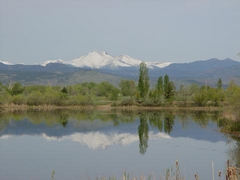
The surrounding area was a private fishing camp in 2008.  In 2016, the Town of Mead purchased the recreational rights to the lake and built a park there (Lorin Mead Park).  It's a fishing, picnicking, and low-impact boating destination only; no swimming allowed due to unknown water quality.  The water in the lake is owned and used by the oil and gas industry.  

The excellent and well-crafted Historic Highlandlake website historichighlandlake.org from 2008 looks like it has transitioned to a slightly renamed site.

Lorin Mead Park today:


The water level of the lake will vary over the year, depending on usage by it's owner:


Despite changes at the lake, the historic church across the street remains constant and well-maintained:


If you're interested in learning more about this community, in 2013 a book was published on the Highlandlake and Mead area:


Friday, February 9, 2018

Dougherty Musem

Despite being just a few miles from where I live, and passing it everyday for twenty years, I had never visited the Dougherty Museum just south of Longmont.  Finally in August of last year (2017), I went inside.

Ray G. Dougherty was a Boulder County poultry farmer and began collecting musical keyboard instruments like organs and the pianos in the late 1920s, along with audio equipment (phonographs, radios, etc.).  In the 40s, he and his wife's interests expanded to vintage cars and farm equipment, with their first acquisition being a 1913  Ford Model T.  As their collection grew, it was stashed but safely preserved, in various storage sheds on their property.  In the 1970s, the Dougherty family decided that their collections had public interest and built a 29,000 square foot building to house a museum.  Ray died in 1988 but the museum continues to this day as a private foundation and is open part of the year in the summer months, June through August.

This is just a sampling of what's inside.  I liked seeing the history of these well-preserved vehicles, including from some manufacturers that I had never heard of.


First, a 1924 "Silver Ghost" Rolls Royce.  6000 of these were made, all hand-built.


One of the oldest bicycles in Longmont, an 1896 Cleveland.  Dougherty was way ahead of his time in collecting vintage stuff and some were even questioning his judgement. I kind of wish he had snapped up more of the early bicycles.


One of the many musical instruments in the Dougherty museum, this one an amazing 1895 foot pump Pianola player-piano, with me at the helm!  It's taken a lot of precision volunteer hours to keep these operating.


The Dougherty's found this 1918 Cadillac Model 57 in a Boulder garage. 


1917 Studebaker, originally owned by the John W. Goss family of Hygiene, Colorado:


Lozier was a short lived Detroit turn-of-the-century car company, started by a bicycle builder.  This 1913 model was made a year before they shut down.


A reminder that electric cars are not a new thing, here's a early 1900's Detroit Electric 84-Volt coupe, top speed 25 mph.  List price was $3300. 


1919 Locomobile, a Connecticut car company, known as the staff car of General Pershing during WWI.


1908 Packard Model 30, found in Basalt, Colorado.


Just one of the many tractors and farm implements at the museum, a 1936 Fordson, manufactured in Dagenhem, UK by Ford and originally purchased by Philip Travarton in 1936 from Cleveland Motors, Longmont.


Speaking of tractors, you can double up on visiting the museum and seeing vintage tractors outside by attending the Yesteryear Farm Show on the Dougherty property, usually at the end of August each year.  That's what I did.   Vintage tractors used to be on display at the annual Boulder County Fair but they now gather at Dougherty instead. The farm show is free and admission to the museum is $5, $3 for kids.


Tuesday, February 6, 2018

Revisited: The Ghost Town of Noland, Colorado

You may remember the sandstone-mining ghost town of Noland, Colorado from the early 1900's in the hills above Lyons, and the fact that today it is on private property with NO TRESPASSING signs on the steep 4WD road leading up to it.  Over the years, I made several attempts to get up there but none of them worked out.

That changed last summer (2017) when an interested party (I'll leave it at that) offered me a legal opportunity to  visit the Noland area!

What's mostly standing up there today are some old buildings in the sandstone quarry areas.  Remember that the town buildings themselves were built of wood and were deconstructed and hauled away via rail when the town faded away.


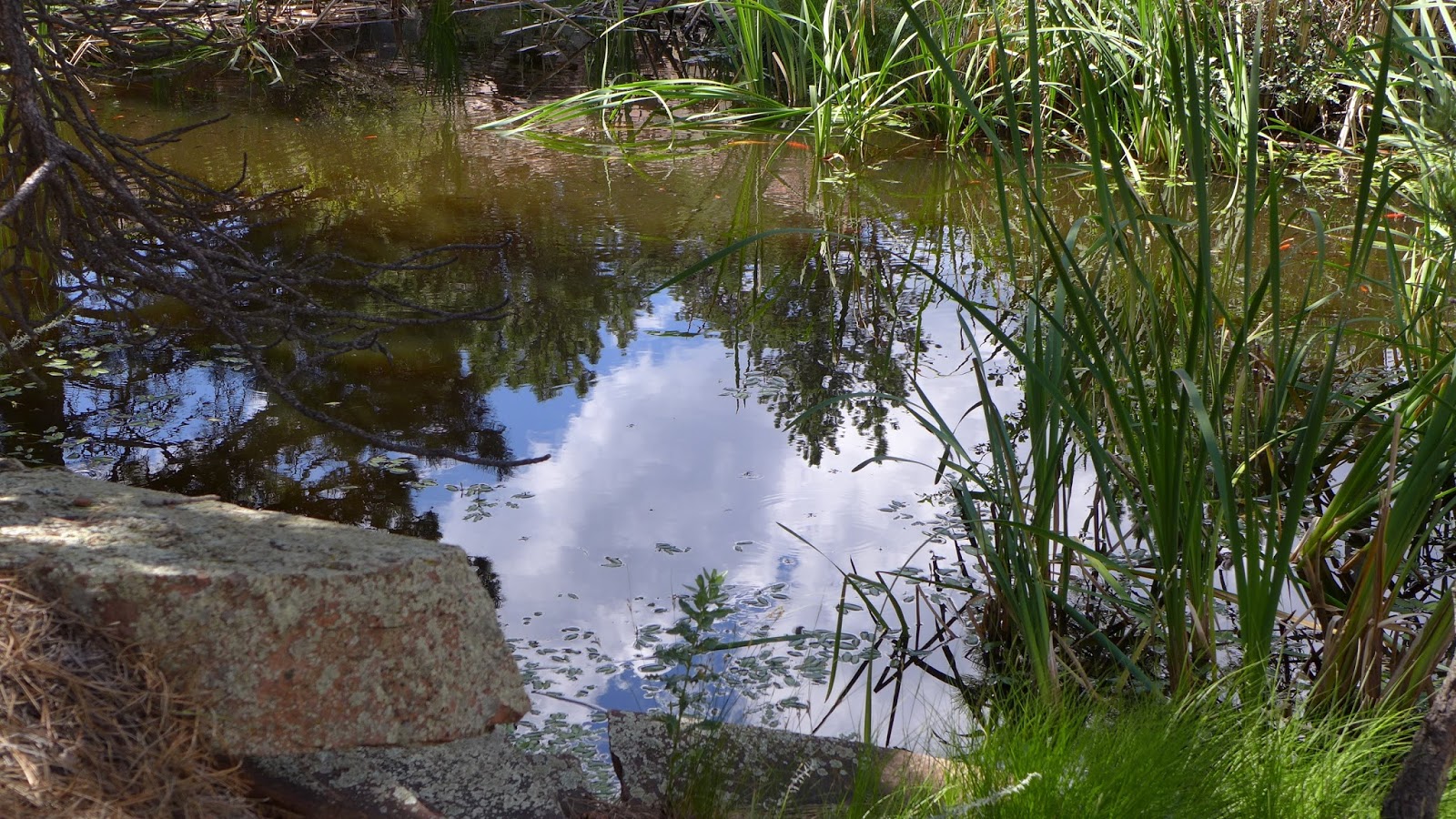
There were a few pools of standing water up there, this one even had some goldfish swimming around in it.  Lack of water was one of the reasons behind the demise of Noland but these little ponds even during wetter summers could not have sustained the town.


This other pool of water had no goldfish and thus was a foul-smelling mosquito haven:


Likely some old quarrying equipment:


More difficult to see but there are old food tin cans laying around:


And lots of large piles of sandstone scraps:


Had to be careful wandering around the brush up there in the middle of summer, as this is prime rattlesnake country.  Nearby Rabbit Mountain was formerly known as Rattlesnake Mountain for this very reason.   More detailed exploring of this area would best be done during the cooler months. 


Thanks again to the friendly "group" that arranged for me to be in the area legally.  Very glad I got to see some of Noland's remains.

Sunday, February 19, 2017

The Beasley School

One of the rewarding things about posting Longmont-area history stories is hearing from readers who experienced it first hand!  Patricia contacted me and said that she was in one of the elementary school classes that transferred during the school year from the Beasley School (previously unknown to me) to the brand new Niwot Elementary School 50 years ago in March 1967.  (See 50 Years for Burlington, Niwot, and Erie Elementary Schools for more about that.)

Patricia said:
"I remember that day well. We started our day out at Beasley and had a farewell party and then all of us loaded on the school bus and moved to the new school finishing up our day at the new school. It was especially exciting as we arrived in time to eat a hot lunch in the brand new cafeteria. That was quite a treat as at Beasley we brought our own lunches and ate at our desks."
Beasley was a two room school house with a first and second grade in 1967.  Older children from the area in grades 3 through 6 attended the old Burlington School about two miles north.

Where was the Beasley School?  Patricia provided me with the locationone-half mile west of US-287 on Niwot Road, making it easy to find on an early 1950s map. 

Red north-south road is US-287.  Niwot Road is east-west dashed red/gray road.


The Beasley School was first built of wood in 1896 and then later of brick in 1907.  It was named after James Jackson Beasley (1831-1907) from Missouri who homesteaded in the south Longmont area in 1871 and formed school district #42 with his neighbors.  The formation of a school district required at least ten children in the area, ages 5 to 21 years, and each district was governed by a three-member school board.  The Beasley School board always included at least two Beasley brothers or a brother-in-law. 

A early 1920s picture of the Beasley School (courtesy of the Longmont Museum  Photo Collection) shows the school before an addition was made to the east side of the building:


Rural schools here were usually built on donated land, facing south or east for protection against the winds from the west.  The trees above appear to be leaning east for that reason.

A 1966 (grainy from microfilm copy) Beasley School photo from the Longmont Times-Call shows the two teachers at the time, Evelyn Delzell (2nd Grade) and Louise Parks (1st Grade), one year before the school closed and transferred to the new Niwot Elementary.  By this time, Beasley was part of the consolidated St. Vrain Valley School District but the historic District #42 sign remained.  Ms. Delzell was in her fourth year at Beasley, Ms. Parks in her fifth and she was at the old Burlington School for 15 years prior.  

Notice the differences from the 1920's picture above, including the eastern addition, no more door overhang, and the additional brick above the door. 


Patricia says that the school playground (with a sit-down merry go-round) was to the left of these steps and perhaps it was recess time or after school when the two curious children above were watching the photographer. 

As you can see, the school had a basement but Patricia said it was only used for storing things and was "dark, dusty, and creepy!" and she hated to go down there.  A bad storm was one reason she remembered when all of the school went to the basement together.  

The Beasley School closed in 1967 after the opening of Niwot ES, having served the eastern Niwot area for 71 years. Here it is partially boarded up in the 70s before it was demolished.   Notice the telephone poles and the trees at the farm to the south, still there today (see picture below).  Photo credits:  Patricia.


Today there are no remaining clues of the Beasley School existence but here's where it was, one half mile west of US-287 on this SE corner of Niwot Road:
 
Beasley School site: looking east

[Edit February 26, 2017:  There does appear to be remaining traces of the Beasley School.  Patricia pointed out the current Google satellite view (last updated in 2012) showing the very outline of the school among a planted crop:


You can't see anything from the Microsoft (Bing) aerial view when the field is plowed:


But another visit out there on foot looking closer indeed reveals the faint rectangular shape of the school.  It may take a soil scientist to explain why this area remains different more than thirty years after the school was razed.  Perhaps they backfilled the basement with a lesser quality soil/fill mix?  If you have an idea, please leave a comment!


So, it does appear that a trace of the Beasley School lives on in 2017.  (End of February 26, 2017 edit)]

Hundreds drive by every day with no evidence that three generations went to school here:
 
Beasley School site:  looking south from Niwot Road


Even though eastern Boulder County has transitioned from the mostly agricultural economy back then, this section of Niwot Road looking straight west at Mt. Audubon from the Beasley School site has not likely not changed much in the last fifty years when the school was still open:


Niwot Road looking west from Beasley School site


Thanks again to Patricia for the valuable first-person insight about the Beasley School, and the two pictures from the 1970s!

If you're interested in other small Boulder County rural school buildings that are still standing, here are two of them:
For anyone interested in rural Boulder County school history, the book "Back to the Basics:  The Frontier Schools of Boulder County, Colorado, 1860 - 1960" (1991) by Niwot's eminent historian Anne Dyni is a valuable reference.  She includes a Beasley School photo from 1912 and some information mentioned here is from this book. 

Saturday, February 4, 2017

50 Years for Burlington, Niwot, and Erie Elementary Schools

The banners are up, three of the elementary schools in the St. Vrain Valley School District (SVVSD) are all celebrating their 50 year anniversary this year.  Burlington, Niwot, and Erie Elementary Schools were effectively identical triplets, of the same design, all starting construction in 1966 by the same company, and all opened in 1967 with matching cornerstones (as you'll see in the pictures below).

Erie Elementary in Erie, Colorado

Niwot Elementary in Niwot, Colorado
Burlington Elementary in Longmont, CO

These schools were born out of severe overcrowding in the school district, a lot due to what was called the "IBM Effect" in the newspaper back then.  In 1965, IBM initiated the construction of a huge new campus on the Diagonal Highway between Boulder and Longmont.  The influx of new IBM employees (and the service industries to support them) saturated the local housing market and immediately overcrowded the schools in the district.  

In late 1965, voters approved a $3 million bond for the school district to address the urgent overcrowding issue.  Of that $3M, $2.2M of bonds were sold for immediate construction of three elementary schools and one junior high school (now Longs Peak Middle School).  With the estimates for the junior high at $1.2M, it was hoped that the three new elementary schools could be built with the remaining $1M.  

Robert Ditzen from Ditzen and Mueler of Boulder was chosen as the architect for the schools and at the August 4, 1966 SVVSD school board meeting, he was told by board President Art Stromquist (see his name on the Burlington plaque below), "You have the go ahead and hurry up", no doubt echoing the community concerns of worsening overcrowding where ten existing classrooms were being leased from two churches.

The winning construction bid came in at $1,269,666 for all three buildings from A. A. & E. B. Jones Co, of Denver which was somewhat over the hopeful $1M cost.  The board approved it anyway and gave Ditzen the green light to modify the design slightly if additional costs could be saved.  Ditzen told the board, "I feel we can negotiate some cost out without hurting the job" and also, "The real education comes inside with teaching.  Good teaching is better than a pretty building."

Other features of the three schools:
  • The buildings would be almost glassless, with one four-foot window in each classroom.
  • Each school would be 27,800 square feet.
  • A flexible classroom scheme was used that clustered four classrooms with no load-bearing walls between them, instead using folding walls that could be opened and closed. 
  • Each school was designed to hold 400-450 students.  Remember that these were K-6 schools back then, not K-5 like today.
  • February 1967 was the target completion date of the schools.  Six months to build three schools!
  • All had a one-year guarantee.

It's strange to think of schools opening mid-year but the overcrowding situation made that necessary.  It was reported that all attempts were made to keep students with the same teacher as they transitioned to the new schools.  Incidentally, SVVSD base pay for a teacher with a bachelor's degree fifty years ago was $5300/year.


Erie Elementary:

Two other names were considered for the Erie School:
  • Erie Union (named after the first school in the area)
  • Valley View (for overlooking the Erie valley)
The District officially moved into Erie Elementary on Monday, March 13, 1967.  The school received its teachers and students from the existing Erie Lincoln and Canfield schools, and Ivan Adams was the principal of the new  school, also coming from Erie Lincoln.

Erie Elementary today:


Niwot Elementary

Unlike Erie and Burlington, there were never alternative names considered for the Niwot school.  Naming committee chairman Vernon Peppler said, "In a small town, the school helps identify the town.  The people of Niwot are very opposed to any other name."

Vic Rehwoldt was named principal of the new Niwot ES, coming from the old Niwot school.  A few students also came to Niwot from the old Burlington school and the Beasley School (This one is new to me, I need to look it up). [Edit February 19, 2017:  Beasley School article posted]

The Niwot school had one small deviation from the design of the other two schools:  a few steps had to be added in one of its hallways.

It was reported on March 9, 1967 that the move into Niwot and Burlington went well with a minimal amount of problems.  "I have never seen a move go as smoothly", reported architect Ditzen.   

  
Niwot Elementary today: 


Burlington Elementary

The other name that was considered for Burlington was "Southmoor Park Elementary" and a petition with 52 signatures was received in support of that name.  In the end, the Burlington name was chosen, given the history of the pre-Longmont Burlington village, and the name of the school (see picture below) it was replacing.

Carl Forgey was named principal of the new Burlington school and it drew students and teachers from five other schools, including the old Burlington school.  

Burlington Elementary today:


The old Burlington School is now the Longmont Buddhist Temple.  Occasionally I will run across people in Longmont that attended school here:


Each school has been expanded a few times in the last 50 years.

A year after the schools were built, two new classrooms each at Niwot and Burlington were constructed by closing in an existing area, at a cost of $22,000.  Even with three new schools and four additional classrooms, the district was not done playing catchup with the IBM Effect and they were still two classrooms short in 1968Portables or continuing to lease space from churches was being considered.

For Burlington, new classrooms were added in 2003 as the district went through another boom time.  Niwot had the exact same expansion, a year earlier I believe.

Before the expansion in May 2003:


 Let the construction begin!


Fifty years is a long time but if you're interested in the history of some of Longmont's much older elementary schools, take a look at these: